Baby boomers will never forget the shock of the sudden emergence of the deadly, sexually transmitted disease AIDS in the early 1980s. And also for Frauke Mücksch’s generation, who graduated from high school in 2008, the public health slogan “Don’t give AIDS a chance” was a constant warning. Today, the issue has receded into the background, as the researcher reports. For younger people in particular, it is often hardly present anymore. This is partly due to the fact that since the mid-1990s, HIV infections can be treated so effectively with medication that, at least in Western industrialized nations, they rarely progress to the fatal final stage of AIDS. However, around 44 million people worldwide have died from the consequences of HIV infection to date. Apart from the plague, HIV is thus responsible for the most devastating pandemic in human history. Despite all the therapeutic advances, HIV infections are still incurable today. This is because some viruses hide so cleverly in the cells they infect that they evade the highly effective drugs and only reappear when these are discontinued. Frauke Mücksch is working on eliminating these dormant viruses once and for all.
Attack on the conductors of the immune system
HIV infections are primarily transmitted through unprotected sexual intercourse. In the 1980s, many people also died from contaminated blood reserves. Once HI viruses have entered the bloodstream, they preferentially attack certain white blood cells, the CD4 T cells. These are the conductors of the adaptive immune defense. The virus fuses its envelope with the membrane of the attacked immune cell and releases its contents into the cell’s cytoplasm. As a retrovirus whose genetic information consists of RNA, HIV must first transcribe this information into DNA. To do this, it has brought along the enzyme reverse transcriptase. To insert itself into the genome of the host cell, HIV uses the enzyme integrase, which is also part of its baggage. From then on, an actively infected T cell produces all the proteins that HIV needs to reproduce. The most important of these is the so-called Gag protein. It is the main structural protein of HIV. It must be anchored to the inner membrane side of the host cell and later precisely cut by the virus’s own protease so that it can initiate the assembly of a functional virus and release it into the bloodstream. In the acute phase of an HIV infection, the viruses multiply explosively in the body. This usually only leads to flu-like symptoms. Many people do not know that they are particularly contagious during this phase. The acute phase is followed by a chronic phase without any significant symptoms. Even if left untreated, it can last for more than ten years, but then inevitably progresses to the stage of acquired immunodeficiency syndrome (AIDS). At this stage, the patient’s immune system collapses almost completely. With permanently swollen lymph nodes, they lose weight dramatically, are constantly exhausted, and eventually die from an infection that would not have harmed a healthy person. In the first decade of the HIV pandemic, infected people had little chance of escaping this fate. This changed fundamentally only after therapies combining at least three different inhibitors of viral enzymes were introduced in 1996. Originally, protease inhibitors played a major role in this. Today, standard antiretroviral therapy (ART) consists of two different reverse transcriptase inhibitors and one integrase inhibitor.
Presenting her doctoral thesis at Cold Spring Harbor
It was not clear from the outset that Frauke Mücksch would specialize in HIV infection research after completing her master’s degree in human biology in Marburg. After earning a bachelor’s degree in biology at Goethe University in Frankfurt, she chose to focus on cell biology in Marburg. “That kept all my options open, because I didn’t yet know whether I wanted to go into tumor research or infectiology.” Her fascination with the interactions between pathogens and their host organisms tipped the scales in favor of infectiology. She therefore explored infectiology working groups for her doctorate. At first, she was not fixated on a specific pathogen. However, she soon discovered that a project at the Graduate School of Heidelberg University particularly interested her. Hans-Georg Kräusslich, director of the Institute of Infectiology there, was about to investigate the molecular mechanisms of the assembly of new HIV viruses in their host cells, with a focus on the Gag protein. Frauke Mücksch joined his group to research the role of lipid-protein interactions. And Mücksch discovered something new: the lipid PIP2, a fatty component of the cell membrane, is not, as originally assumed, only necessary to guide Gag to the membrane. It also ensures that Gag remains in the membrane . When it is missing, the Gag proteins detach from the membrane again, causing the HIV construction site to collapse. Even before she defended her doctoral thesis in December 2017 with a summa cum laude grade, Frauke Mücksch presented her findings at a Cold Spring Harbor conference on Long Island in May. After her presentation, Paul Bieniasz from Rockefeller University approached her. Her work would be a good fit for his lab. Would she like to come in for an interview?
Unexpectedly at the heart of the pandemic
“Of course I wanted to. I had been following his work for some time, and this was an incredible opportunity for me,” recalls Mücksch. She completed some more work in Heidelberg before moving to Manhattan in 2019. Building on the innovative methodology of her doctoral thesis, she researched further aspects of the assembly of new HI viruses there. “However, my main goal was to start something completely new, namely to investigate the phenomenon of HIV latency.” An HI virus that has transcribed its RNA into DNA and integrated it into the host genome is called a provirus. The genetic information of this provirus is either actively read, resulting in the creation of new HI viruses, or it is not read. The provirus enters a dormant state. Its genetic material is preserved, but it does not produce new viruses. It remains invisible to the immune system and HIV drugs. After a year of intensive research into this phenomenon of latency, however, there was an “unexpected twist,” as Mücksch puts it. The SARS-CoV-2 pandemic swept over humanity. And like so many virology labs around the world, Paul Bieniasz’s lab threw its resources into researching COVID-19 – with such competence that Frauke Mücksch quickly published her first two papers in Nature, which is quite an achievement at a time when a flood of papers without peer review were being published on preprint servers. In New York, Frauke Mücksch had the privilege of conducting research at the heart of the pandemic, in collaboration with immunologist Michel Nussenzweig and his research group.
How our antibodies stand up to the coronavirus
Just a few weeks after the outbreak of the pandemic, researchers at Rockefeller University, with the participation of Mücksch, analyzed antibodies in the blood of patients who had just recovered from SARS-CoV-2 infection. They found that although some of these people had only small amounts of antibodies against the virus’s spike protein, they had always formed some memory B cells with very potent antibodies that could be stimulated to produce an effective antibody response. This was such clear evidence of the prospects for a successful vaccine that Nature published the study in mid-June. In the following period, Mücksch demonstrated that antibodies against the coronavirus can keep pace with its mutations and block its variants’ escape routes from the immune system. As soon as the mRNA vaccines against SARS-CoV-2 became available in December 2020, she and her colleagues set up a study with previously uninfected subjects, whose antibody status they measured in 2021 after the first, second, and third vaccinations. The last booster proved to be particularly effective, greatly improving immunological memory. Although the vaccines had been developed against the wild-type coronavirus, many of the antibodies present after the third vaccination were effective against the Omicron variant that had since emerged. “The immune response is evolving and becoming increasingly broad,” explains Mücksch. “Even though a virus is constantly changing, vaccinations can build up stable immune protection against it.” Nature published this work in April 2022.
The world’s largest cell library for latency research
At that time, Frauke Mücksch was already beginning to look toward Heidelberg again. There, she had the prospect of receiving a five-year research grant from the Chica and Heinz Schaller Foundation for her HIV research. Her application was successful. Generously funded, she has been leading her own research group at the Institute of Infectious Diseases since the summer of 2022. With her team, she wants to find the factors that determine whether HIV replicates or hides in a CD4 T cell. The immunological knowledge she acquired in New York is helping her in this endeavor, as is the change in perspective she learned there. “We looked less at the virus and more at the host.” She is now taking the same approach with regard to HIV latency. Cell by cell, she is examining the integration sites where HIV latency occurs – using a method she had already developed in New York. She links a modified HI virus to the gene for a green fluorescent protein. She then infects human T cell lines with it. Cells in which the provirus leads to HIV replication light up because the green protein is also expressed there. Cells in which the proviruses enter latency, on the other hand, remain dark. They are then separated from the glowing cells using flow cytometry and magnetic cell sorting. Mücksch then cultivated a new cell line from each individual dark cell. In this way, she has created a library of hundreds of clonal cell lines – the largest and most heterogeneous library of latently HIV-infected CD4 T cells worldwide. Her team has now expanded this library to include cells of monocyte origin. “We compare the data from our cell lines with that from patient databases,” says Frauke Mücksch. “For example, we select cells with particularly interesting integration sites for genome-wide CRISPR-Cas screens.” In this process, a different gene is switched off in each T cell to find out whether and how it influences the development of latency. Mücksch and her team also use these libraries and various primary cell models of HIV latency to investigate how exactly the specific integration site affects the persistence of the provirus and its reactivability. “My goal is to identify the molecular characteristics of proviruses that resist reactivation.”
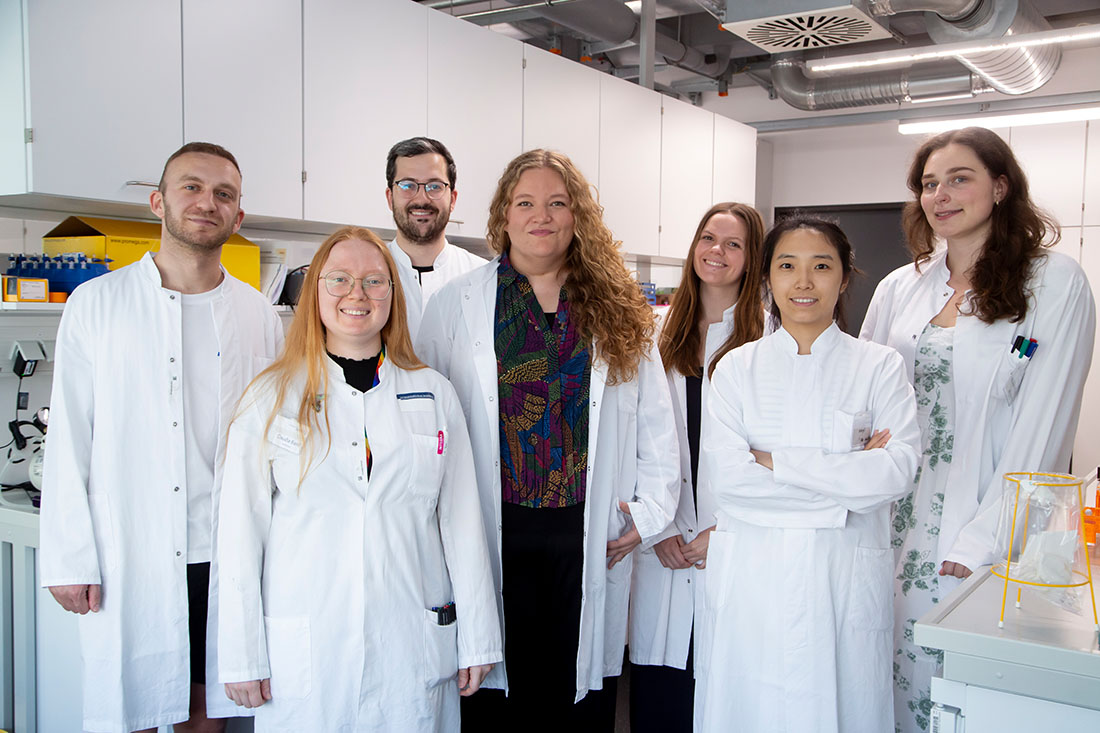
Frauke Mücksch hopes that this approach will lead to a better understanding of latency regulation and the development of latency-reversing agents (LRAs) that truly deserve the name. To do so, they would have to effectively and tolerably implement a “shock-and-kill” strategy, i.e., wake up and reactivate dormant viruses so that they can be recognized and killed by the immune system. Most of the LRAs tested to date originate from cancer research. They only reach a subset of the latency reservoir and do not show sufficient clinical efficacy. “In our screens, we have discovered factors that are known to be targets of previous LRAs,” says Mücksch. “This shows that these screens work.” Epigenetic approaches, which could potentially silence latent HI viruses once and for all as part of a “block-and-lock” strategy, are still relatively new in the very active field of HIV latency research. “There will probably never be an LRA that covers everything,” says Frauke Mücksch. “But in combination with immune boosters and antibodies, it might be possible to achieve a functional cure. To do this, however, we first need to better understand the molecular mechanisms of HIV latency and persistence.”
Her goal: a normal life for 40 million infected people
A functional cure would enable more than 40 million HIV-infected individuals to undergo only temporary ART therapy and then lead a normal life. Even with effective drug therapy, people with HIV often have to endure persistent inflammation and activation of the immune system. Even if their medications no longer had serious side effects, their viral load was well controlled, and they could reach an advanced age, quite a few HIV patients still suffered from lifelong comorbidities, especially cardiovascular disease, neurodegenerative symptoms, and an increased incidence of certain types of cancer, not to mention ongoing stigmatization, says Frauke Mücksch. “My goal is for people living with HIV not only to reach old age, but to be able to lead just as healthy a life as people who have never been infected with HIV.” The Aventis Foundation is supporting her on her way to a permanent professorship with a Life Sciences Bridge Award.
Author: Joachim Pietzsch, Wissenswort
Photos: © Uwe Dettmar
1 Mücksch F, Laketa V, Müller B, Schultz C, et al. Synchronized HIV assembly by tunable PIP2 changes reveals PIP2 requirement for stable Gag anchoring. eLife 6:e2528 (2017)
2 Muecksch F, Wang Z, Cho A, Gaebler C, et al. Increased memory B cell potency and breadth after a SARS-CoV-2 mRNA boost. Nature 607, 128-134 (2022)


)