In retrospect, major discoveries often seem so obvious that one wonders why they were not made much earlier. This also applies to the discovery that Varun Venkataramani made by chance while working on his medical doctoral thesis at Heidelberg University. It concerns particularly malignant brain tumors known as glioblastomas. What no one knew until 2015, when Venkataramani was the first to see it through an electron microscope, was that the tumor cells, also known as glioma cells, form electrochemical connections (synapses) with the nerve cells of the brain. Through these synapses, glioblastomas pick off impulses from the nervous system that promote their division and accelerate their spread. This surprising discovery, which Venkataramani validated and expanded upon over the past decade together with his mentors and colleagues in Heidelberg and in cooperation with a research group at Stanford University, has given rise to the new field of cancer neuroscience, to which the European Association for Cancer Research (EACR) will dedicate an entire conference for the first time this October. Above all, however, this discovery has led to new therapeutic approaches for previously incurable brain tumors.
In a stronghold of brain tumor research
An estimated 86 billion nerve cells (neurons) work in the human brain. Almost all of them are mature and no longer capable of dividing. This means that they cannot give rise to brain tumors – but glial cells, whose total number is similar to that of neurons, can. Glioblastomas are particularly dangerous. They usually arise from neuronal precursor cells. Glioblastomas grow very quickly. Within a month, they double in volume and infiltrate the brain along the nerve pathways in all directions. Even with the best available treatment according to current standards, the average survival time is a maximum of 18 months. Basic researchers and clinicians in Heidelberg are working intensively to improve this grim prognosis. This is where Varun Venkataramani, a native of Hanover, found himself in a stronghold of brain tumor research after deciding to study medicine after completing his civil service in Ratingen. He was also attracted to Heidelberg by the prospect of being accepted into the MD/PhD program for a dual degree in medicine and natural sciences. A scholarship from the German National Academic Foundation gave his education additional momentum. Venkataramani always remained a tinkerer who enthusiastically developed new research methods. Consequently, he chose a more technology-related doctoral topic for his MD, supervised by Heinz Horstmann, a pioneer of advanced electron microscopic methods.
The favor of presence of mind
Heinz Horstmann had developed a preparation that made it possible to view glioma cells in an electron microscope that remain hidden by magnetic resonance imaging (MRI) – namely, those cells of the tumor that diffuse through the brain from its main mass. Horstmann tasked his doctoral student with further developing this method and examining and describing the ultrastructure of neuronal synapses. Then a discovery by Frank Winkler, head of the neighboring Department of Neurology, suddenly expanded Venkataramani’s research horizon. Winkler had discovered that the tumor cells of a glioblastoma spin off extremely thin and long projections, similar to nerve fibers, which connect to form a dense network during the growth of the tumor, as if they were forming a new brain within an existing one. “Frank Winkler asked us to use an electron microscope to determine what the inside of these tumor cell projections looks like.” However, the doctoral student’s open mind did not remain focused on the inside, but wandered to the outside. And there, quick-witted and astonished, he lingered on a section of the image: what he saw there on one of the tumor cell extensions was clearly a synapse with a nerve cell! It sounded so crazy that neither Winkler nor Horstmann nor his boss Thomas Kuner could believe it at first. “We were all very skeptical about it for years,” says Venkataramani. “But it was clear to me that we had to pursue it.” He considered it a stroke of luck that he was able to do so in his doctoral thesis in natural sciences under the aegis of Kuner and Winkler. The top journal Nature apparently considered the results, which Venkataramani submitted for publication in September 2018, so unusual that it assigned four external experts to review them, who asked many critical questions. All of them were answered thoroughly and satisfactorily. Almost a year after submission, Nature published Venkataramani’s paper.
Nerve currents promote cancer growth
“Our discovery did not fit with the traditionally prevailing view that the tumor is the center of attention and everything around it is incidental,” says Venkataramani. Although oncology had been paying increasing attention to the blood vessels and immune activity in the tumor’s environment, it had not considered that nerve cells could also influence tumors. Had he perhaps only seen an artifact in the electron microscope? He was able to refute this electrophysiologically. The synapses on the tumor cells were functioning. Signals from nerve cells arrived at their presynaptic end and triggered the release of the neurotransmitter glutamate, which docked postsynaptically to AMPA receptors on the tumor cells, causing calcium ions to flow in, which in turn generated an electric current. Now, this sequence of presynaptic nerve fibers and postsynaptic tumor cell fibers suggests that it is the nerve cells that seek contact with the tumor cells. However, all evidence to date suggests the opposite. The tumor cell is characterized by gene expression patterns that cause postsynaptic fibers to sprout. These fibers entice the nerve cell to grow toward it with presynaptic fibers. The more input glioma cells receive from nerve cells, i.e., the more they are wired to neurons, the more aggressively they drive their growth and spread. Their embedding in neural circuits probably also explains the high resistance of glioblastomas to therapy compared to other brain tumors.
A methodological masterpiece
“How neural input triggers the tumor’s signaling pathways remains an open question,” says Venkataramani. Thanks to his technological expertise, however, he was able to answer the question of how glioblastomas manage to spread so quickly in the brain. Together with his team, he combined a series of advanced methods into a workflow that overlays imaging and molecular profiling. Human glioma cells labeled with a green dye were implanted into the brains of immunodeficient mice to observe their growth in vivo. This was done using a two-photon microscope, whose images were merged into moving images in time-lapse. AI algorithms were used to denoise and interpret the images. In addition, a red dye was injected. It was only absorbed by glioma cells that were interconnected. Non-interconnected cells continued to glow green. “These cells migrated criss-cross into the brain.” Using flow cytometry, the different colored tumor cell types were then separated from each other and subjected to single-cell RNA sequencing to study their molecular inner workings. This revealed that the invasive green glioma cells not only bear a strong internal resemblance to immature nerve cells, but also “hijack” their mechanisms of propagation, as Venkataramani calls it. Their movements are reminiscent of the migration of immature nerve cells during brain development . “Like mimicry of immature neurons,” says Venkataramani, “a little eerie when you consider that they also receive direct electrical support from normal neurons.”
An epilepsy drug against glioblastomas
The Heidelberg researcher and his colleagues are therefore hopeful that there are already drugs that could stop the flow of electricity between nerve and tumor cells in the brains of glioblastoma patients. These drugs inhibit the effect of the neurotransmitter glutamate. They are approved for the treatment of epilepsy, which is characterized by excessive activation of glutamatergic signaling pathways. Because glutamate also chemically mediates the electrical coupling of neurons and glioma cells, the efficacy of the two older antiepileptic drugs gabapentin and levetiracetam against glioblastomas has already been tested with some success. However, this was done in retrospective studies. Both drugs also have nonspecific mechanisms of action and only indirectly affect glutamate signals. The situation is different with perampanel, which has been available in Europe since 2012. This is a selective AMPA receptor antagonist. It therefore blocks precisely the site through which glioma cells receive nerve impulses. Venkataramani and his colleagues therefore selected this epilepsy drug for repurposing and are developing it for the previously unapproved indication of glioblastoma. Because the authorities already have a lot of data from the original approval, this development is progressing rapidly and has already reached phase II of clinical trials. It is a prospective, multicenter study. The preclinical results have been encouraging, says Venkataramani. However, perampanel has a narrow therapeutic window. It must therefore be dosed carefully to avoid serious side effects. “Nevertheless, I hope that perampanel will have an effect on growth in the diffuse infiltration zone.” But for him, perampanel is the beginning and not the end of the development of effective glioblastoma therapies.
A therapeutic trick takes the tumor off the grid
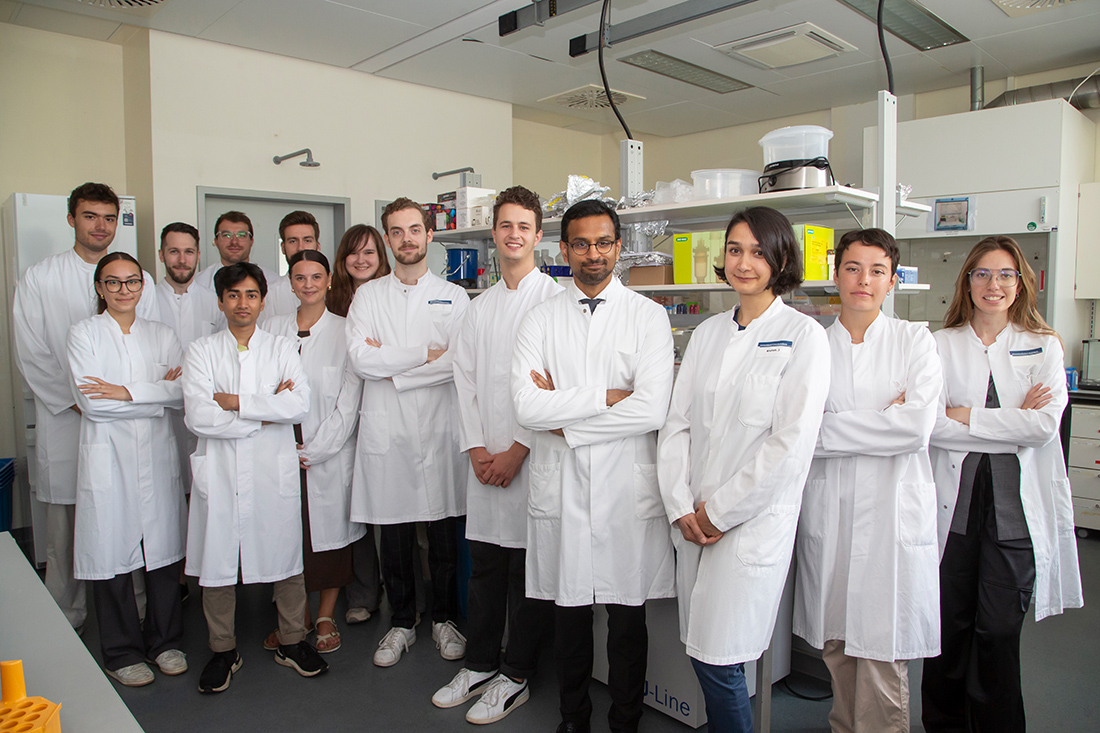
Since 2022, Varun Venkataramani has been leading his own 15-member research group at Heidelberg University Hospital. Technology and therapy development go hand in hand in this group, as demonstrated by their recent brilliant publication . It provides preclinical proof of concept for a gene therapy procedure that could one day also be used clinically for the diagnosis and treatment of glioblastomas. The aim of this procedure is to mark and switch off the nerve cells associated with a tumor. In this so-called retrograde virus tracing, tumor cells are prepared so that they can take up modified rabies viruses that carry a fluorescent dye. The viruses spread backwards in the postsynaptic extensions of the tumor cells through their presynaptic fibers into connected nerve cells. They do not spread any further. Only the network of neurons directly connected to the tumor lights up under the microscope. The cells in this network can be selectively killed using the following trick: First, viral gene vectors are used to transport the inactive precursors of a gene into all nerve cells in the wider vicinity of the tumor. Activation of this gene causes these cells to commit suicide (apoptosis). The activation signal is incorporated into the modified rabies viruses. As a result, only the neurons associated with the tumor kill themselves, effectively disconnecting the tumor from the power grid. “This is, of course, a drastic approach,” says Venkataramani. “But it could be groundbreaking.” A combination of gene therapy and pharmacological measures, together with standard chemotherapy and radiation, could have the potential to eliminate glioblastomas.
Teamwork to decode the tumor connectome
However, Venkataramani says he sees his fundamental task as decoding the “tumor connectome”. The tricky thing about this network of tumor and nerve cells is that it begins to form unnoticed in a glioblastoma stage that is still largely symptom-free. The more precisely this process is understood at the molecular, cell biological, and pathophysiological levels, the sooner targets for early intervention will be found. For a clinician scientist who combines clinical duties with research activities, this challenge is extremely demanding. However, research will never be a secondary activity for him, as he has already received many prestigious awards for his pioneering work. This inspires him, but does not make him lose touch with reality. “All this work we are talking about now is clearly the work of a great many people,” he says. “I am delighted to receive recognition, but I know that no award can reflect the reality of research, where every achievement can only be accomplished as part of a team.” The Aventis Foundation is supporting him on his way to a permanent professorship with a Life Sciences Bridge Award.
Author: Joachim Pietzsch, Wissenswort
Photos: © Uwe Dettmar
1 Venkataramani, V., Tanev, D.I., Strahle, C., Studier-Fischer, A., Fankhauser, L., Kessler, T., Körber, C., Kardorff, M., Ratliff, M., and Xie, R. (2019). Glutamatergic synaptic input to glioma cells drives brain tumor progression. Nature 573, 532-538. http://dx.doi.org/10.1038/s41586-019-1564-x
2 Venkataramani, V., Yang, Y., Schubert, M.C., Reyhan, E., Tetzlaff, S.K., Wißmann, N., Botz, M., Soyka, S.J., Beretta, C.A., and Pramatarov, R.L. (2022). Glioblastoma hijacks neuronal mechanisms for brain invasion. Cell 185, 2899-2917. e31. http://dx.doi.org/10.1016/j.cell.2022.06.054
3 Tetzlaff, S. K., E. Reyhan, N. Layer, C. P. Bengtson, A. Heuer, J. Schroers, A. J. Faymonville, A. P. Langeroudi, N. Drewa, E. Keifert, J. Wagner, S. J. Soyka, M. C. Schubert, N. Sivapalan, R. L. Pramatarov, V. Buchert, T. Wageringel, E. Grabis, N. Wissmann, O. T. Alhalabi, M. Botz, J. Bojcevski, J. Campos, B. Boztepe, J. G. Scheck, S. H. Conic, M. C. Puschhof, G. Villa, R. Drexler, Y. Zghaibeh, F. Hausmann, S. Hanzelmann, M. A. Karreman, F. T. Kurz, M. Schroter, M. Thier, A. K. Suwala, K. Forsberg-Nilsson, C. Acuna, J. Saez-Rodriguez, A. Abdollahi, F. Sahm, M. O. Breckwoldt, B. Suchorska, F. L. Ricklefs, D. H. Heiland, and V. Venkataramani.* Characterizing and Targeting Glioblastoma Neuron-Tumor Networks with Retrograde Tracing. Cell 188, 390-411 e36. http://dx.doi.org/10.1016/j.cell.2024.11.002.


)